
- Former Haas team principal Guenther Steiner believes Fred Vasseur remains the right person to lead Ferrari, but warns that a change in leadership should be considered if the Scuderia fails to deliver championship success within the next two years.
- Steiner criticised Ferrari’s costly opening-lap clash between Lewis Hamilton and Charles Leclerc in Mexico City, arguing that mutual respect and responsibility towards the team are more effective than rigid rules of engagement.
- The Italian-American identified excessive expectations and a lack of stability as significant obstacles to Ferrari’s championship ambitions, urging the organisation to give Vasseur the time and confidence required to deliver results.
Former Formula 1 team principal Guenther Steiner believes Fred Vasseur remains the right man to lead Ferrari back to championship contention, although he has warned that the Frenchman’s position should be reconsidered should the Scuderia fail to deliver within the next two years.
Ferrari’s prolonged pursuit of championship success has continued to attract considerable scrutiny, with the Italian outfit struggling to consistently convert its considerable resources and technical capabilities into sustained dominance.
And while the Maranello operation has demonstrated flashes of competitiveness throughout the 2026 campaign, its inability to maximise opportunities has remained a source of frustration.
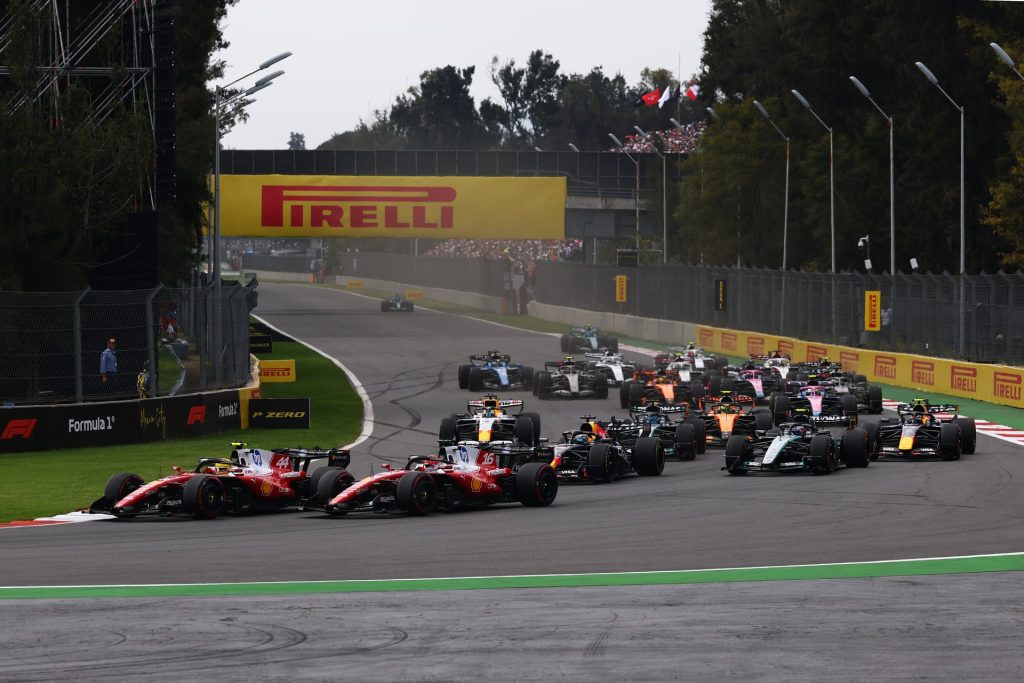
The most recent example came at the Mexico City Grand Prix, where an opening-lap battle between Lewis Hamilton and Charles Leclerc compromised Ferrari’s prospects of securing victory.
Speaking exclusively to Motorsport Reports ahead of his upcoming No Team Orders tour of Australia and New Zealand, Steiner suggested that the incident represented a missed opportunity, although he acknowledged that the outcome could never be established with certainty.
“It was a possibility of a win they threw away,” Steiner said.
However, rather than advocating for an increasingly complicated set of instructions governing interactions between teammates, the former Haas boss believes the solution is considerably more straightforward.
Respect.
“There needs to be respect between the drivers to have respect to the team,” he explained.
“It’s very difficult to have proper rules of engagement of situations you cannot predict.”
Steiner argued that attempting to legislate for every conceivable racing scenario was ultimately futile, given the unpredictable nature of wheel-to-wheel competition.
“Nobody will know what happens in Turn 1. You can maybe write down a thousand different scenarios, but there will be scenario 1001.”
Instead, he believes Ferrari’s drivers must recognise the broader responsibilities associated with representing the team.
“The drivers need to understand where is the line, where is the line? And the line is respect to the team.”
Steiner questions McLaren’s Papaya Rules
The discussion also prompted Steiner to offer a typically forthright assessment of McLaren’s much-publicised Papaya Rules, which have governed the interactions between Lando Norris and Oscar Piastri.
Despite the considerable attention surrounding the policy, Steiner admitted he remains unconvinced by its effectiveness or even its precise definition.
“I still haven’t understood what the Papaya Rules are,” he said.
“Neither I think has McLaren, to be honest.”
The former Haas team principal went further, dismissing the concept in characteristically blunt fashion.
“I think that was a lot of BS, the Papaya Rules.”
For Steiner, the underlying principle remains that drivers must be trusted to race competitively while recognising when their actions threaten the team’s interests.
An approach which, he believes, cannot be adequately captured through an exhaustive list of predetermined scenarios.
Ferrari’s greatest obstacle may be its own expectations
Beyond the events in Mexico City, Steiner identified a broader issue which continues to undermine Ferrari’s pursuit of championship success.
While acknowledging that technical performance remains fundamental, he suggested that the relentless expectations surrounding the organisation create an environment in which progress is too often overshadowed by disappointment.
“The expectation needs to be managed,” Steiner stressed.
“You’ve got pressure anyway in Formula 1. There’s no need for unnecessary pressure.”
Unlike its rivals, Ferrari carries the expectations of an entire nation, alongside a global supporter base accustomed to measuring success almost exclusively through championships.
And while that passion remains central to the marque’s identity, Steiner believes it can become counterproductive.
“Finishing second is not disappointment. Finishing second is a way to be the winner.”
“If you talk finishing second so badly, people lose their confidence and then they cannot get to first.”
The Italian-American suggested that Ferrari already possesses much of the infrastructure and personnel required to challenge for titles, with stability representing a more pressing concern than wholesale organisational change.
“I think a little bit of stability is missing. I think all the rest can be fixed and the infrastructure at Ferrari is very good.”
“The quality of people is good. It’s just like, let them get on with that, leave them alone.”
Yet he conceded that escaping the relentless scrutiny surrounding Ferrari was an almost impossible proposition.
“Ferrari will always be the most scrutineered team of all of them.”
Vasseur deserves time, but not indefinitely
Despite the pressure surrounding Vasseur, Steiner offered a vote of confidence in the Frenchman’s leadership.
Having established relationships throughout the organisation and overseen several seasons of development, Steiner believes another managerial change at this stage could prove counterproductive.
“In the moment I wouldn’t know who would be better qualified,” he explained.
“He knows the people. Now is the time he needs to make it happen.”
However, that endorsement came with a qualification.
“In my opinion, if it doesn’t happen in two years, then you have to consider the change.”
Steiner acknowledged that Ferrari continues to face significant challenges, but argued that the organisation must provide its leadership with the opportunity to address those shortcomings without unnecessary distractions.
“Let them work in peace, and the peace doesn’t mean not pushing them, but in peace, not distracting them.”
For a team whose recent history has been punctuated by changes in leadership and direction, the message was clear.
Ferrari’s pursuit of championship glory will require more than simply producing a competitive car.
It demands an environment in which the people responsible for delivering success are afforded the confidence, stability and time to achieve it.
And while Steiner believes Vasseur remains capable of ending the Scuderia’s prolonged championship drought, his patience is not without limits.
