
The McLaren F1 was conceived with an unusual benchmark in mind. Gordon Murray, the legendary engineer behind the road car, once posed a simple, unscientific question during its development: Would you want to drive it to the south of France?
Despite becoming one of the most extraordinary road cars ever built, and still, more than two decades later, the fastest naturally aspirated production car in history, the McLaren F1 was never designed to go racing. Competition was never part of the brief.
That changed thanks to McLaren’s customers.
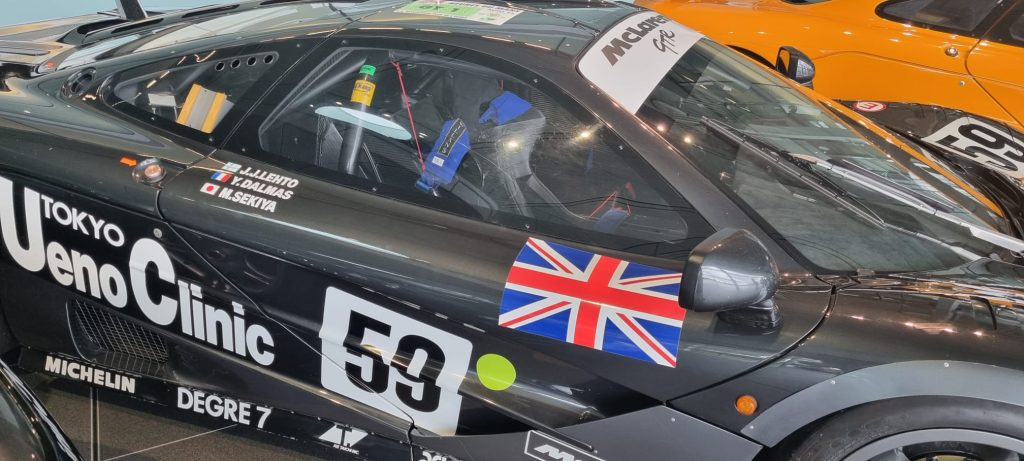
Owners of the F1 began urging the company to create a race-ready version, and the result was the McLaren F1 GTR. While the car was cleverly adapted for competition, it remained something of an afterthought. Yet once it hit the track in early 1995, the GTR quickly proved its potential, winning endurance races wherever it appeared.
Naturally, attention soon turned to the ultimate test, the 24 Hours of Le Mans.
McLaren invited its customers to a 24-hour test at Magny-Cours in late May. According to project engineer Jeff Hazell, the car ran flawlessly, but the reaction from owners was unexpected.
“The car hardly missed a beat and I thought the owners would be happy,” Hazell recalled. “Instead, they were quite glum. They said, ‘We thought we were going to Le Mans, have a thrash, and be back at the hotel for dinner. Now we’ll need more spares, more people, and to take this much more seriously.’”
Alongside the customer entries, Lanzante Motorsport was tasked with running a works-backed car for a Japanese sponsor. The driving lineup featured two-time Le Mans winner Yannick Dalmas, Japanese endurance veteran Masanori Sekiya, and former Formula 1 driver JJ Lehto.
“Our goal was simply to bring the car home in one piece,” Lanzante explained. “We weren’t racing flat out. We pushed, but not recklessly. We were especially careful with the gearbox, topping up oil at every stop. We preserved the car.”
The race began under dry but overcast skies before the weather turned brutal. Heavy rain set in, followed by thick overnight fog and relentless spray that made conditions treacherous. Amid the chaos, a McLaren F1 GTR emerged at the front, and one of the cars would hold that position all the way to the finish.
As darkness fell, JJ Lehto, the least experienced endurance racer in the lineup, delivered a standout performance.
“He was astonishing,” Hazell admitted. “We asked him to slow down. He replied, ‘I already have. I’m having fun.’ He was spinning the wheels on the straights and drifting through chicanes. I didn’t think we needed to go that fast to win, but it became clear just how strong the car was.”
Lanzante shared a similar moment of disbelief.
“I saw him on the monitors, hanging the rear out in the wet. I radioed him to calm down. He replied while still drifting, ‘Don’t worry, it’ll be okay.’ Having JJ was a huge advantage.”
As the finish drew closer, the team shifted from a defensive approach to carefully measured aggression.
“We pushed a little more,” Dalmas explained, “but always with the philosophy of protecting the car. When the conditions allowed, we attacked. Winning wasn’t certain, but with every hour, belief grew.”
That belief was rewarded spectacularly. At the chequered flag, the Dalmas–Sekiya–Lehto entry led home a stunning McLaren 1–3–4–5 finish, an extraordinary result for a debutant at Le Mans, achieved with a car never intended to race.
“Our success came from the fact that so much of the car was still a road car,” Hazell said. “It was waterproof, balanced, predictable, and incredibly driveable in the wet. The naturally aspirated engine, weight distribution, and reliability all mattered. The conditions suited us, the drivers were perfect for it everything aligned.”
For Dalmas, the victory carried special weight.
“I’ve raced for Peugeot, Porsche, BMW, and McLaren. Winning with McLaren is something unique. When you win with that name, you enter history.”
Gordon Murray ultimately summed it up best.
“Winning Le Mans is harder than winning a Formula 1 championship,” he said. “It’s an entire season compressed into one race. It wasn’t just that we won, it was how we won, on debut, with a production-based GT car against prototypes. That was something truly special. I was against racing the F1 at first, but I’m glad it happened. My only regret is that we didn’t drive the winning car there and back. That would have been the ultimate statement.”
