

- Australian Formula 1 legend Alan Jones has passed away aged 80 following a short illness, leaving behind an enduring motorsport legacy.
- Jones secured the 1980 Formula 1 world championship with Williams, becoming the team’s first drivers’ champion and Australia’s second.
- With 12 Grand Prix victories, Jones helped establish Williams as a powerhouse and inspired generations of Australian racing drivers.
Australian motorsport has lost one of its most influential figures, with 1980 Formula 1 world champion Alan Jones passing away at the age of 80 following a short illness.
The Melbourne-born racer, whose uncompromising driving style and fierce determination helped transform Williams into a championship-winning powerhouse, remains the last Australian to have claimed Formula 1’s ultimate prize.
Jones’ passing was confirmed on Thursday, November 5, just three days after celebrating his 80th birthday, bringing to an end a remarkable life dedicated to motorsport.
His wife, Amanda Butler-Davis, confirmed the news in a statement released through Motorsport Australia.
“We are extremely saddened to announce the passing of our beloved Alan, who passed away on 5 November following a short illness,” the statement read.
“He will be dearly missed and fondly remembered by those closest to him, as well as the many fans whose support he was always grateful for.”
For Australian Formula 1 supporters, Jones represented considerably more than a world champion.
He was a pioneer whose achievements helped cement Australia’s standing on the international motorsport stage, following in the footsteps of the legendary Sir Jack Brabham.
From Melbourne to the pinnacle of Formula 1
Born on November 2, 1946, Jones inherited a passion for motorsport from his father Stan, himself a successful racer and winner of the 1959 Australian Grand Prix.
Determined to forge his own path, Jones departed Australia for Europe in 1970, embarking upon a difficult journey through the junior categories at a time when opportunities for aspiring Australian drivers were particularly limited.
His persistence was eventually rewarded with a Formula 1 debut for Hesketh in 1975, although the early years of his Grand Prix career were characterised by the challenges of competing for smaller, underfunded outfits.
A breakthrough arrived at the 1977 Austrian Grand Prix, where Jones secured an unexpected maiden victory for Shadow, demonstrating the tenacity and racecraft which would become hallmarks of his career.
The performance attracted the attention of Frank Williams, who was establishing his fledgling team as an independent constructor.
Jones joined Williams in 1978, beginning a partnership which would fundamentally alter the trajectory of both driver and team.
After emerging as a regular frontrunner in 1979, the Australian entered the following campaign with genuine championship aspirations.
And in 1980, those ambitions were emphatically realised.
Driving the formidable Williams FW07B, Jones secured five Grand Prix victories in Argentina, France, Britain, Canada and the United States, alongside another five podium finishes.
His triumph in Canada ultimately secured the championship with one round remaining, making Jones only the second Australian to win the drivers’ crown after Brabham.
It was also Williams’ maiden drivers’ championship, establishing the foundations for an organisation which would subsequently become one of Formula 1’s most successful constructors.
A champion who helped define Williams
Jones’ contribution to Williams extended well beyond his championship-winning campaign.
His aggressive yet calculated approach, combined with an unrelenting determination to extract performance, proved instrumental in transforming the British outfit from an ambitious newcomer into a genuine Formula 1 powerhouse.
The Australian remained a championship contender in 1981 before initially stepping away from full-time competition.
However, his competitive instincts ultimately prompted a return, including appearances for Arrows and a final stint with the Haas Lola operation.
Jones concluded his Formula 1 career in 1986, having accumulated 12 Grand Prix victories across ten seasons.
His achievements were particularly significant given the formidable opposition of an era featuring Nelson Piquet, Gilles Villeneuve, Niki Lauda and Alain Prost.
Yet Jones was never one to be intimidated by reputation.
His direct manner and uncompromising approach made him a formidable adversary on the circuit, while establishing a personality which remained unmistakable long after his retirement.
An enduring Australian motorsport legacy
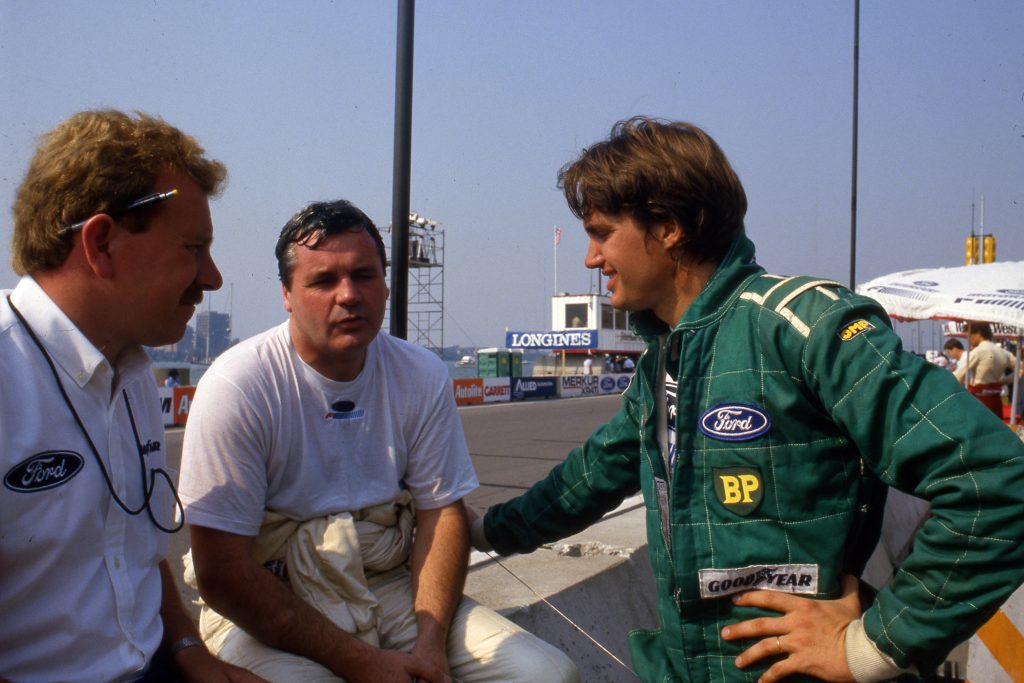
Beyond Formula 1, Jones continued his involvement in motorsport through touring car competition and a subsequent career as a television commentator.
His forthright analysis and willingness to challenge conventional thinking made him a familiar voice to generations of Australian racing enthusiasts.
Recognition of his contribution included appointment as a Member of the Order of the British Empire and induction into the Sport Australia Hall of Fame.
More than four decades after his championship triumph, Jones remains one of only two Australians to have secured the Formula 1 drivers’ title.
While the likes of Mark Webber, Daniel Ricciardo and Oscar Piastri have carried Australian aspirations onto the international stage, Jones’ achievement remains an enduring benchmark.
His family’s statement reflected upon a life whose influence extended far beyond the trophies and accolades.
“Through his achievements, passion and unmistakable character, both on and off the track, Alan left an enduring mark on the sport both nationally and across the globe.”
For Williams, Jones will forever be remembered as the driver who delivered its first world championship.
For Australian motorsport, he was a trailblazer who demonstrated that a determined racer from Melbourne could conquer the world’s most prestigious racing championship.
And for Formula 1, his legacy is that of an uncompromising competitor whose contribution helped shape one of the sport’s defining eras.
Alan Jones leaves behind a legacy that transcends generations, his place amongst Australia’s greatest sporting champions forever assured.
